Philosophy of Junior
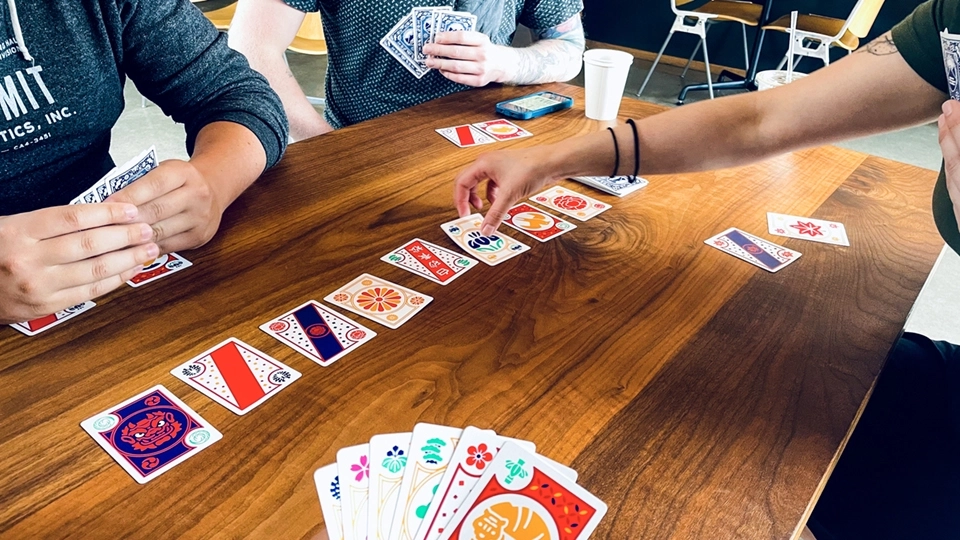
Four people playing Koi-Koi with Junior Hanafuda.
The philosophy of Junior is that playing games should enrich time spent with friends and family.
Both the design and writing from Junior reflect this purpose by facilitating social interactions rather than burdening them with over-complicated rules, making clear distinctions about the difficulty levels of each game, and selling versatile game components.
Social
Any multi-player game is inherently between people, with the game merely facilitating the social environment. That’s why—in Junior game rules—social aspects that don’t impact gameplay are handled by the players themselves.
“Shuffle the deck and deal” cards based on preference. Maybe one player shuffles and the other cuts the deck. Alternate between players to deal. What works for the players works for the game.
In any turn-based game, one player must play first. Junior game rules simply state, “Choose a player to begin.” This is determined by the players, because it largely doesn’t have a noticeable impact in gameplay.
Junior suggests embracing ties rather than breaking them. That’s why Junior says, “Rejoice in the shared victory!” Friends are not adversaries. No one has to win if everyone has fun. But if players absolutely must break a tie, just play another round.
Inclusive
A name like “Junior” might make this all seem juvenile, but games and products from Junior are made for everyone. Cards and dice are designed with clear iconography, colors, and patterns for easy differentiation.
Game rules are published online rather than printed in booklets, so that they may be referenced simultaneously, translated into other languages by browsers, and so that people can perform text searches within a rules page.
Complex rules are simplified or set aside as variations. And if traditional scoring is too complex, Junior often suggests a simpler alternative. This all reduces the amount of focus required to play games with friends and family.
Even with rule simplification, each game varies, and is therefore is placed into one of three minimum-age groups, with clear factors that differentiate them. Everyone learns differently, so these groupings are not hard restrictions, but rather guidance to help players to find the most suitable games for each other.
- 4+: following directions
- 6+: making choices
- 8+: considering strategy
Flexible
Junior card decks are typical poker-size, which make them easily pocketable. And dice sets are small enough to fit into a little bag. These compact packages allow them to be super portable, which increases the chance of playing games anywhere, at any time.
Unlike most board games, each Junior product supports many different games, most of which are short and only require a small surface to play, making them perfect for a café, a picnic, or even an airplane.
Rather than selling games, Junior sells the components needed to play games. Each product from Junior is open to interpretation and experimentation, where players can invent new ways to play games with adaptable parts.