Momiji

2 Players, Ages 6+
Momiji 紅葉 ▶ maple / autumn leaves is a 2-player hanafuda game. The goal is to capture valuable cards to score points and form yaku 役 ▶ set.
This game is a Junior original, created by Louie Mantia. Bearing similarity to Sakura, it primarily differs with drafting, unique yaku, and simpler scoring.
Cards
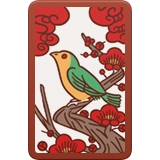
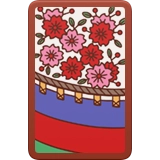
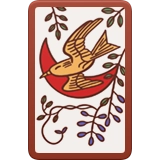
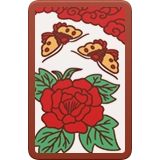
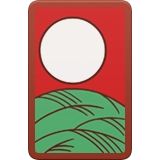
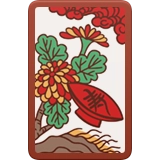
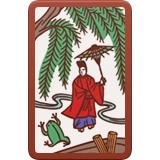
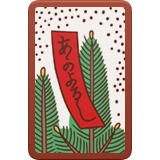
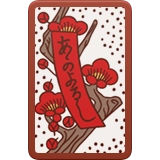
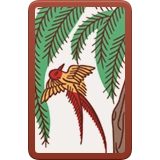
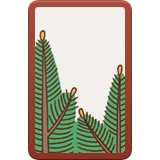
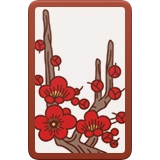
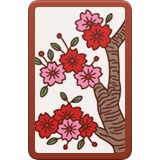
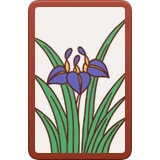
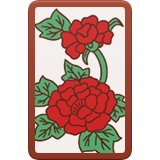
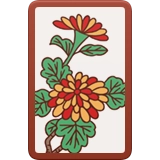
This game uses a 48-card hanafuda deck.
 |
 |
 |
 |
 |
 |
 |
 |
 |
 |
 |
 |
|---|---|---|---|---|---|---|---|---|---|---|---|
 |
 |
 |
 |
 |
 |
 |
 |
 |
 |
 |
 |
 |
 |
 |
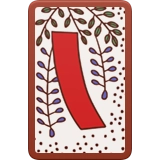 |
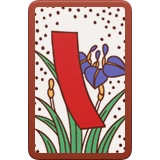 |
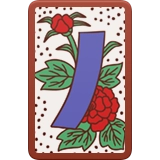 |
 |
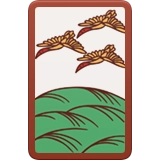 |
 |
 |
 |
 |
 |
 |
 |
 |
 |
 |
 |
 |
 |
 |
 |
 |
 |
 |
 |
 |
 |
 |
 |
 |
 |
 |
 |
 |
If you’re using a Junior Hanafuda deck, be sure to set aside its extra cards.
Setup
Shuffle the deck and deal ten cards to the field. Place the remaining deck adjacent to the field.
|
|
|
|
|
 |
|
|
|
|
|
Alternating between players, each selects one card from the field for their hand until all cards have been taken. Next, deal ten new cards to the field, repeating the process.
If either player has captured all four cards of a single month, they instantly win the round, scoring 5 points!
Deal eight cards to the field.
 |
||||
|
|
|
|
|
|
|
|
|
|
|
||||
If all four cards of a single month are dealt into the field, shuffle and start over.
Gameplay
Goal
The goal of Momiji is to match and capture cards from your hand with cards in the field to score points and form three-card yaku for bonus points.
Your Turn
When your turn begins, try to match a card from your hand with a card from the same month in the field.
If you find a match, you capture these cards. Place both cards face-up in front of you.
If you find two matches, you may only capture one of them with the card you introduced to the field. However, if the card matches three cards in the field, you may capture all four.
If you cannot make a match, you must surrender a card from your hand into the field.
Your captured cards are displayed face-up in front of you, away from the field. It’s best to organize them by rank (Hikari, Tane, Tanzaku, Kasu) rather than by month.
Next, draw a card from the deck into the field, following the same pattern as above.
After playing from your hand and playing from the deck, your turn is over. Now it’s the next player’s turn.
Continue until all cards are depleted.
Scoring
At the end of the round, each player tallies the points of their captured cards according to the following table. For this game, Hikari, Tane, and Tanzaku are worth 1 point each. All Kasu are 0 points.
| Hikari | Tane | Tanzaku | Kasu |
|---|---|---|---|
| 1 | 1 | 1 | 0 |
|
Rainy HanamiCurtain, Rainman, Sake |
25 | |||
|
TsukihiCrane, Cuckoo, Moon |
25 | |||
|
Ino-shika-chōBoar, Deer, Butterflies |
25 | |||
|
ToriWarbler, Geese, Swallow |
25 | |||
|
MuriPhoenix, Bridge, November Tanzaku |
25 | |||
|
Akatan3 Poetry Tanzaku |
25 | |||
|
Aotan3 Blue Tanzaku |
25 | |||
|
Kusatan3 Plain Tanzaku, excluding November Tanzaku |
25 | |||
Series
Games are best played in a series of 3, 6, or 12 rounds. The player with the highest total score at the end of the series wins!
If the players have identical scores, rejoice in the shared victory!
Strategy
During the setup, players select cards from the field to form their hand. This is a unique opportunity to see which cards your opponent has.
Half of the deck is worth no points. Prioritize capturing valuable cards to form yaku. With each combination valued at 25 points, it’s worth the effort. Each non-Kasu card is used in a yaku, with no overlaps.